Price Monitoring ScrapeGraphAI Slack Alerts Jira Integration Competitive Intelligence

Automated product price tracking with ScrapeGraphAI, Slack alerts and Jira tickets

Monitor competitor prices 24/7 with AI-powered scraping, get instant Slack notifications for price drops, and automatically create Jira tickets for pricing strategy adjustments

Download Template JSON · n8n compatible · Free
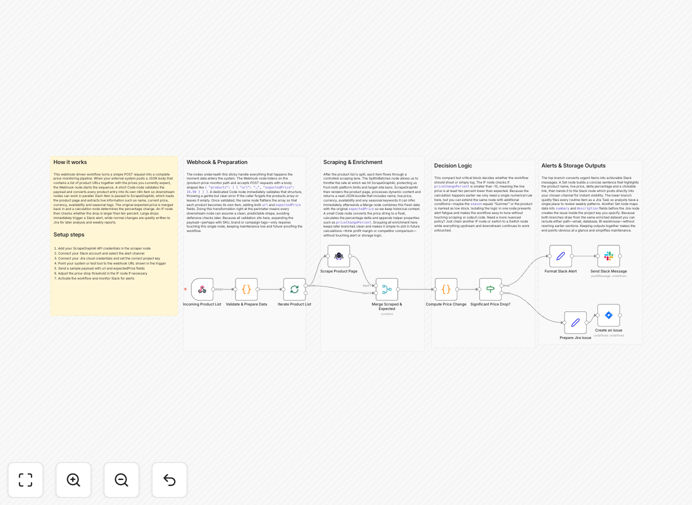
Automated price tracking workflow diagram showing ScrapeGraphAI, Slack and Jira integration

What This Workflow Does

This automation solves the critical business challenge of staying competitive in dynamic markets by continuously monitoring competitor pricing. Manual price tracking is time-consuming, error-prone, and can't scale across hundreds of products. This workflow uses ScrapeGraphAI to extract pricing data automatically, analyzes changes, and triggers appropriate team responses through Slack alerts and Jira tickets.

The system helps ecommerce businesses, retail chains, and manufacturers maintain price competitiveness without dedicating staff to constant monitoring. When integrated with your existing tools, it creates a closed-loop system where price intelligence directly informs strategic decisions and tactical responses.

Price monitoring workflow interface preview
Workflow interface showing price extraction, analysis, and notification steps

How It Works

1. Scheduled price scraping with ScrapeGraphAI

The workflow begins by automatically visiting competitor product pages at scheduled intervals (daily/hourly). ScrapeGraphAI's AI engine identifies and extracts pricing information even from complex, dynamic pages that traditional scrapers might miss.

2. Price change analysis

Extracted prices are compared against your reference prices and historical data. The system calculates percentage changes and applies your business rules to determine significance (e.g., 5% drop triggers alert).

3. Slack notifications for urgent changes

When prices cross your defined thresholds, formatted Slack messages are sent to designated channels with product details, old/new prices, and direct links. Teams can react immediately without checking dashboards.

4. Jira ticket creation for strategic actions

For significant or sustained price changes, the workflow automatically creates Jira tickets with all relevant data. Tickets route to appropriate teams based on your rules - marketing for promotions, procurement for supplier negotiations, etc.

Pro tip: Configure different Jira ticket types and priorities based on the magnitude of price changes and affected product categories.

Who This Is For

This workflow delivers the most value for:

  • Ecommerce businesses competing on price-sensitive products
  • Retail chains needing centralized competitor price monitoring
  • Brands enforcing minimum advertised price (MAP) policies
  • Businesses using dynamic pricing strategies
  • Teams that need to coordinate quick responses to competitor moves

What You'll Need

  1. n8n instance (cloud or self-hosted)
  2. ScrapeGraphAI API access
  3. Slack workspace with webhook permissions
  4. Jira Cloud or Server instance
  5. List of competitor product URLs to monitor
  6. Your reference pricing data

Quick Setup Guide

  1. Download and import the JSON template into your n8n instance
  2. Configure ScrapeGraphAI credentials and target URLs
  3. Set up Slack webhook for your notification channel
  4. Connect Jira with appropriate project/ticket type mappings
  5. Define your price change thresholds and alert rules
  6. Test with sample products before full deployment

Key Benefits

Reduce price monitoring costs by 80%: Automating this process eliminates the need for dedicated staff to manually check competitor sites daily.

React to price changes 10x faster: Instant alerts mean your team can adjust pricing or launch promotions within minutes instead of days.

Maintain perfect pricing records: Automated systems don't miss checks or make transcription errors like human teams might.

Enable data-driven pricing strategies: Historical price trends provide insights for your own pricing and promotion planning.

Improve cross-team coordination: Automated Jira tickets ensure the right teams see price intelligence when they need it.

Frequently Asked Questions

Common questions about price tracking integration and automation

Most ecommerce businesses benefit from daily price monitoring for key competitors. For fast-moving markets like electronics or fashion, tracking every 6-12 hours may be necessary. The ideal frequency depends on your industry's price volatility and how quickly you need to react to maintain competitive positioning.

Grocery retailers might check prices weekly, while electronics sellers often need hourly monitoring during product launches. Consider both your competitors' pricing change frequency and how quickly you can operationally respond when setting your monitoring schedule.

  • Daily checks suit most retail products
  • High-velocity items may need hourly monitoring
  • Align tracking frequency with your response capability

Automated price tracking eliminates human error in data collection, works 24/7 without breaks, and processes data faster than manual methods. It also allows for historical price trend analysis that would be impractical to maintain manually, giving businesses better insights for dynamic pricing strategies.

A clothing retailer automating price checks saved 35 hours/week previously spent manually checking 200 competitor SKUs. Their automated system also identified weekend discount patterns they'd previously missed, allowing them to time promotions more effectively. The data helped increase margins by 3% while maintaining price competitiveness.

  • No missed checks during holidays/weekends
  • Consistent data formatting for analysis
  • Scalable to thousands of products

Modern AI scraping tools like ScrapeGraphAI achieve 95-98% accuracy for price extraction when properly configured. They can handle dynamic pricing pages, detect sale prices versus regular prices, and account for regional pricing variations. The key is training the AI on your specific competitor sites and product layouts.

An electronics retailer using AI scraping found it correctly identified bundle pricing, temporary discounts, and member-only prices that traditional scrapers missed. After initial training on 50 sample products, the system maintained 97% accuracy across their 2,000-SKU monitoring program with weekly accuracy audits.

  • Configure fallback checks for critical products
  • Regularly audit scraped data accuracy
  • Update AI models when sites redesign

Dynamic pricing, price matching guarantees, and promotional pricing strategies see the greatest benefits. Businesses using these approaches need real-time competitor data to adjust prices quickly while maintaining margins. Automated tracking also helps identify when competitors are running temporary discounts you may want to match.

A furniture retailer with price matching used automated tracking to reduce price adjustment time from 48 hours to 2 hours. Their system automatically flags products where competitors' sale prices drop below their cost thresholds, allowing immediate review rather than waiting for customer complaints.

  • Essential for real-time repricing systems
  • Identifies competitor flash sales instantly
  • Supports data-driven promotional planning

Slack alerts create instant visibility across teams without requiring dashboard checks. Pricing teams get mobile notifications for significant price changes, while automated workflows can trigger immediate actions like inventory adjustments or marketing responses. This reduces reaction time from hours/days to minutes.

A sporting goods company configured Slack alerts to ping different channels based on product category - #footwear-alerts for shoe price changes, #fitness-alerts for equipment. This routed notifications directly to category managers who could respond fastest, cutting their average response time from 8 hours to 47 minutes.

  • Mobile notifications enable immediate action
  • Route alerts by product category/channel
  • Include direct links to competitor pages

Jira integration turns price data into actionable tasks. When competitors drop prices below thresholds, tickets automatically route to relevant teams - marketing for promotions, product for feature comparisons, or finance for margin analysis. This ensures price intelligence drives concrete business decisions.

An auto parts distributor's system creates Jira tickets tagged "Pricing Review" when competitors undercut their prices by 10%. The tickets include historical pricing graphs and automatically assign to regional pricing managers based on product category, ensuring localized responses within their SLA timeframe.

  • Creates audit trail of pricing decisions
  • Ensures follow-through on competitive moves
  • Aligns with existing workflow tools

Yes, GrowwStacks specializes in building tailored price monitoring systems that match your specific competitors, products, and business rules. We can integrate with your existing tech stack, add custom analytics dashboards, and set up automated response workflows based on your pricing strategy.

Our team has built systems tracking everything from daily grocery prices to real-time airline ticket fluctuations. We'll design a solution that fits your operational capabilities while maximizing the competitive advantage from price intelligence. Custom implementations typically deliver ROI within 3-6 months through improved margins and market positioning.

  • Tailored to your product catalog
  • Integrated with your business systems
  • Scalable as your needs grow

Need a Custom Price Tracking Integration?

This free template is a starting point. Our team builds fully tailored automation systems for your specific needs.