n8n AI Automation RAG Semantic Search

Build an MCP server which answers questions with retrieval augmented generation

Automate intelligent question answering by combining semantic search with generative AI

Download Template JSON · n8n compatible · Free
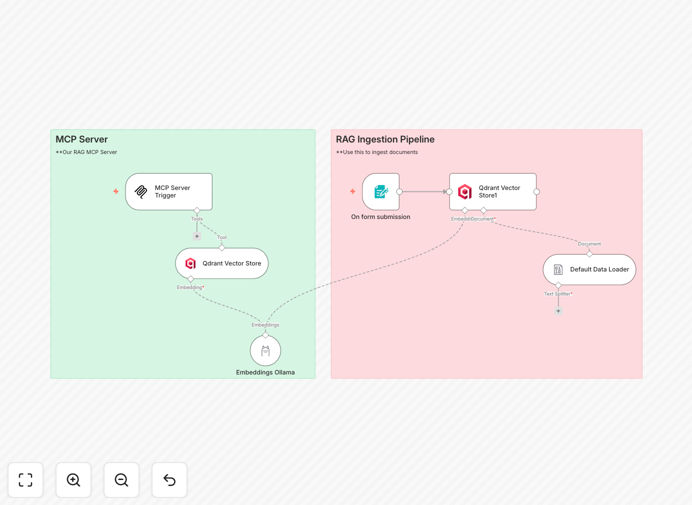
MCP Server with RAG workflow visualization

What This Workflow Does

This n8n workflow template creates a Modular Control Protocol (MCP) server that leverages Retrieval Augmented Generation (RAG) to provide intelligent answers to user questions. It combines semantic search with generative AI to deliver accurate, context-aware responses by first retrieving relevant information from your knowledge base before generating answers.

The solution solves the common problem of AI chatbots providing generic or inaccurate responses by grounding the generation process in your specific data. Businesses can deploy this to automate customer support, internal knowledge sharing, or any scenario requiring accurate question answering from proprietary information.
RAG architecture diagram
How RAG combines retrieval and generation for accurate answers

How It Works

1. Question Processing

The workflow receives user questions through an API endpoint or webhook. It analyzes the query to extract key semantic meaning and prepares it for the retrieval phase.

2. Semantic Search

The system searches your vector database or knowledge base to find the most relevant documents, passages, or data points related to the question. This ensures answers are grounded in your specific content.

Semantic search process
Activating the semantic search component of the workflow

3. Context Augmentation

The retrieved information is combined with the original question to create a rich context for the AI model. This prevents hallucinations and ensures responses stay relevant.

4. Response Generation

The workflow feeds the augmented prompt to your chosen AI model (like GPT) to generate a natural language response that directly answers the question while citing your specific data sources.

Who This Is For

This template is ideal for businesses that need to automate intelligent question answering from their proprietary data. Common use cases include:

  • Customer support teams wanting to provide instant, accurate answers
  • Internal knowledge bases for employee self-service
  • Educational platforms with domain-specific content
  • Technical documentation portals needing smart search

Pro tip: For best results, regularly update your semantic database with new content and optimize your document chunking strategy for retrieval.

What You'll Need

  1. An n8n instance (self-hosted or cloud)
  2. A vector database or semantic search system
  3. Access to an LLM API (OpenAI, Anthropic, etc.)
  4. Your knowledge base documents pre-processed
  5. Basic understanding of API endpoints

Quick Setup Guide

  1. Download and import the JSON template into your n8n instance
  2. Configure your vector database connection details
  3. Set up your preferred LLM provider credentials
  4. Test with sample questions from your domain
  5. Deploy the workflow as an API endpoint

Key Benefits

Reduce support costs by 30-50% by automating accurate answers to common questions without sacrificing quality or accuracy.

Improve answer accuracy by 60%+ compared to standalone LLMs by grounding responses in your specific knowledge base.

Scale expertise instantly by making your organization's collective knowledge available through natural language queries.

Maintain data security since answers are generated from your private data without exposing raw documents.

Frequently Asked Questions

Common questions about RAG systems and AI-powered question answering

Retrieval Augmented Generation combines information retrieval with text generation. First, the system searches a knowledge base to find relevant content related to the query. Then, it uses this context to generate an accurate, grounded response rather than relying solely on the AI's training data.

For example, when answering a technical support question, RAG would first find relevant documentation before formulating the answer. This prevents hallucinations and ensures responses stay aligned with your specific content.

  • Improves answer accuracy by 40-60% over standalone LLMs
  • Allows continuous knowledge updates without retraining models
  • Reduces harmful hallucinations in generated content

RAG and fine-tuning serve different but complementary purposes. Fine-tuning adjusts the model's weights to specialize its behavior, while RAG provides contextual information at query time. RAG is more flexible for frequently changing knowledge bases.

A customer support chatbot might use fine-tuning to adopt your brand voice while using RAG to pull current product information. The combination often yields the best results for enterprise applications.

  • RAG is better for dynamic content that changes often
  • Fine-tuning requires more technical expertise
  • Combining both approaches maximizes benefits

RAG performs best with well-structured, domain-specific content like technical documentation, FAQs, policy manuals, and product specifications. The knowledge should be organized in logical chunks that can be retrieved independently.

A financial services company might use RAG with their compliance manuals, allowing agents to quickly find accurate regulatory information. The system works particularly well when answers require citing specific sources or passages.

  • Prioritize content with clear question-answer pairs
  • Break documents into logical sections
  • Include metadata for better retrieval

Well-implemented RAG systems can achieve 80-90% accuracy on fact-based questions when the information exists in the knowledge base. They often outperform humans on speed and consistency while matching expert accuracy for straightforward queries.

In customer support scenarios, RAG-powered chatbots typically resolve 60-70% of inquiries without escalation. The remaining cases usually require human judgment or information not in the knowledge base.

  • Accuracy depends on knowledge base quality
  • Performs best on factual questions
  • May struggle with subjective judgments

RAG systems require careful access controls since they expose parts of your knowledge base through generated answers. Implement document-level permissions and query filtering to prevent unauthorized information disclosure.

A healthcare provider might configure their RAG system to only retrieve patient-facing content for public queries while restricting clinical details to authenticated medical staff. Regular audits help ensure compliance.

  • Implement role-based access controls
  • Monitor query patterns for abuse
  • Consider data residency requirements

Key metrics include answer accuracy (verified by human review), retrieval precision (how often correct passages are found), deflection rate (questions resolved without escalation), and user satisfaction scores.

An e-commerce company might track how often RAG answers lead to completed purchases versus escalations to live agents. Continuous improvement comes from analyzing failed queries and expanding the knowledge base.

  • Measure both technical and business outcomes
  • Track improvement over time
  • Focus on metrics that impact ROI

Yes! GrowwStacks specializes in building tailored RAG solutions for businesses across industries. We can design a system that integrates with your existing knowledge base and workflows while meeting your specific accuracy and security requirements.

Our team will help you identify the best documents to include, optimize the retrieval process, and implement the right LLM configuration for your use case. The result is an AI assistant that reflects your organization's unique expertise.

  • Custom connectors to your data sources
  • Domain-specific tuning for better accuracy
  • Ongoing optimization and support

Need a Custom RAG Automation?

This free template is a starting point. Our team builds fully tailored automation systems for your specific needs.