AI Automation Proposals Typeform GPT-4 PandaDoc

AI Proposal Generator: Typeform to PandaDoc with GPT-4

Turn discovery call forms into polished, personalized proposals in seconds. Automate your entire proposal workflow from capture to delivery.

Download Template JSON · n8n compatible · Free
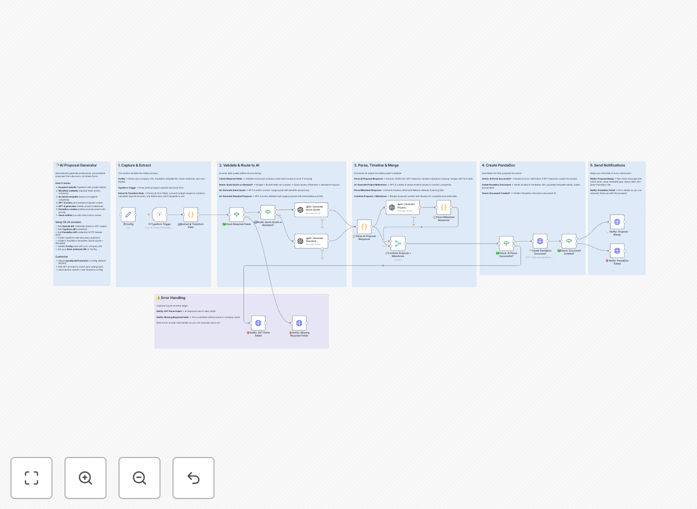
AI Proposal Generator workflow diagram showing Typeform, GPT-4, and PandaDoc integration

What This Workflow Does

This automation solves one of the most time-consuming tasks for service businesses: writing personalized proposals. Instead of spending hours researching, drafting, and formatting documents for each prospect, this workflow creates professional, tailored proposals in under 30 seconds.

The system captures detailed prospect information through a Typeform discovery questionnaire, uses GPT-4 to analyze their needs and write compelling proposal content, then automatically generates a polished PandaDoc document complete with pricing tables, project timelines, and personalized recommendations.

It eliminates manual data entry, ensures consistency across all proposals, and allows you to respond to prospects faster than competitors—increasing conversion rates while reclaiming valuable business development time.

How It Works

1. Prospect Submission

A potential client fills out your Typeform discovery questionnaire with details about their company, challenges, budget, and project requirements. The workflow validates that all essential fields (email, company name) are completed before proceeding.

2. Intelligent Template Selection

Based on the prospect's budget and project complexity, the workflow automatically selects the appropriate proposal template. Quick Quote templates are used for simple projects under $2,500, while Standard Proposal templates handle more complex or higher-value engagements.

3. AI-Powered Content Creation

GPT-4 analyzes the prospect's challenges and writes personalized proposal content that directly addresses their pain points. It generates specific benefits with measurable metrics (time savings, cost savings), creates realistic 4-phase project timelines, and crafts a compelling challenge summary.

4. Document Generation & Delivery

The system populates your PandaDoc template with all generated content, including personalized fields, pricing tables, and expiration dates. Once the document is created, you receive a Slack notification with a direct link to review and send to the prospect.

Who This Is For

This workflow is ideal for freelancers, consultants, digital agencies, marketing firms, and any service-based business that regularly sends proposals. If you find yourself rewriting similar content for different clients, spending hours on document formatting, or missing opportunities because proposal creation takes too long, this automation will transform your process.

It's particularly valuable for businesses handling 5+ proposals per month, teams with multiple salespeople needing consistent branding, and companies wanting to implement AI without technical complexity.

What You'll Need

  1. OpenAI API account (costs approximately $0.05-0.15 per proposal)
  2. Typeform account (free tier works perfectly)
  3. PandaDoc account with API access
  4. Slack workspace for notifications
  5. n8n instance (cloud or self-hosted)

Pro tip: Start with a semi-automated approach. Have the AI draft the proposal and send it to you via Slack for review before it goes to the client. This maintains quality control while still saving 80% of the time.

Quick Setup Guide

  1. Import the template into your n8n instance using the downloaded JSON file.
  2. Add credentials for OpenAI, Typeform, and PandaDoc in their respective nodes.
  3. Create your Typeform with the recommended discovery questions (company name, industry, challenges, budget range, etc.).
  4. Set up PandaDoc templates with the placeholder tokens mentioned in the workflow description.
  5. Configure the Settings node with your company information, template IDs, and Slack webhook URL.
  6. Test the workflow by submitting a test Typeform response and verifying the proposal generates correctly.

Key Benefits

Save 2-4 hours per proposal. What used to take an afternoon now happens in seconds, freeing you to focus on higher-value activities like client strategy and business development.

Increase response speed by 95%. Prospects receive professional proposals within minutes of submitting their discovery form, dramatically improving conversion rates compared to days-long wait times.

Ensure consistent quality and branding. Every proposal follows your approved templates, maintains your brand voice, and includes all necessary components—no more forgetting important sections or using outdated pricing.

Scale without adding overhead. Handle 10x more proposals without hiring additional staff. The system works 24/7, capturing leads and generating documents even when you're not working.

Make data-driven improvements. With all proposal data captured in one system, you can analyze which approaches convert best, identify common prospect challenges, and continuously optimize your offerings.

Frequently Asked Questions

Common questions about proposal automation and AI integration

The most effective way is to connect a discovery form tool like Typeform with AI (like GPT-4) and a document generator like PandaDoc. This creates a seamless pipeline where prospect information is captured, AI writes personalized content, and a professional proposal is generated automatically, saving hours per client.

This approach maintains the human touch through personalization while eliminating repetitive tasks. The key is designing intelligent workflows that route to appropriate templates based on project complexity and budget.

Businesses typically save 2-4 hours per proposal. Manual proposal writing involves research, drafting, formatting, and pricing calculations. Automation reduces this to minutes, allowing you to respond to prospects faster and handle more opportunities without increasing overhead.

The time savings compound significantly. At 10 proposals per month, you reclaim 30-40 hours—almost an entire work week—that can be redirected to client work, business development, or strategic planning.

Yes, modern AI like GPT-4 can produce highly personalized, professional proposals when given proper context. The key is feeding it specific prospect challenges, industry details, and your unique value proposition.

The AI then crafts content that addresses their pain points directly, often outperforming generic templates. With well-designed prompts that include your company voice and examples of past successful proposals, the output becomes indistinguishable from human-written content.

You need three core components: 1) A form tool (Typeform, Google Forms), 2) An AI service (OpenAI GPT-4), and 3) A document generator (PandaDoc, DocuSign). An automation platform like n8n connects these tools, routing data between them and handling logic like template selection based on budget.

Additional helpful tools include Slack for notifications, a CRM to track prospects, and analytics to measure conversion rates. The beauty of automation is you can start simple and add complexity as needed.

Implement validation rules and review checkpoints. Use standardized templates with your branding, create AI prompt templates that include your company voice, and set up Slack notifications for each generated proposal so you can review before sending.

Automation ensures consistency while you maintain quality control. Start with requiring human approval for every proposal, then gradually automate more as you gain confidence in the system's output.

  • Create a library of approved proposal sections
  • Implement A/B testing for different AI prompts
  • Regularly review and update your templates

Absolutely. For small businesses, time is the most valuable resource. Proposal automation converts administrative hours into business development time. The ROI is immediate—you can respond to more leads faster with professional proposals, increasing conversion rates while reducing the stress of manual document creation.

Even solo entrepreneurs benefit dramatically. The system pays for itself after just a few proposals, and the competitive advantage of rapid, professional responses can be the difference between winning and losing projects.

Common mistakes include: Over-automating without human review points, using generic AI prompts that produce bland content, not testing the full workflow end-to-end, and forgetting to update templates regularly.

The most successful implementations start simple and iterate. Begin with automating just the content generation while keeping manual review and sending. Once that works reliably, automate the document creation, then notifications, and finally the entire pipeline.

  • Test with real past proposals first
  • Involve your sales team in design
  • Plan for edge cases and exceptions

Yes, GrowwStacks specializes in building custom automation solutions tailored to your specific business processes. We can integrate your existing CRM, design custom AI prompts that match your brand voice, and create multi-step approval workflows that fit your sales process perfectly.

Our team works with you to understand your unique requirements, then builds a system that automates not just proposals but your entire client onboarding workflow. We handle the technical complexity so you can focus on growing your business.

  • Integration with your current tools
  • Custom AI training on your past proposals
  • Ongoing support and optimization

Need a Custom Proposal Automation?

This free template is a starting point. Our team builds fully tailored automation systems for your specific business needs.