n8n Google Sheets Competitive Analysis

Detect e-commerce platforms & technology stacks with Google Sheets

Automatically identify Shopify, WooCommerce, Magento stores plus their payment processors, analytics tools, and frameworks. Save hours of manual research with this production-ready n8n workflow template.

Download Template JSON · Zapier compatible · Free
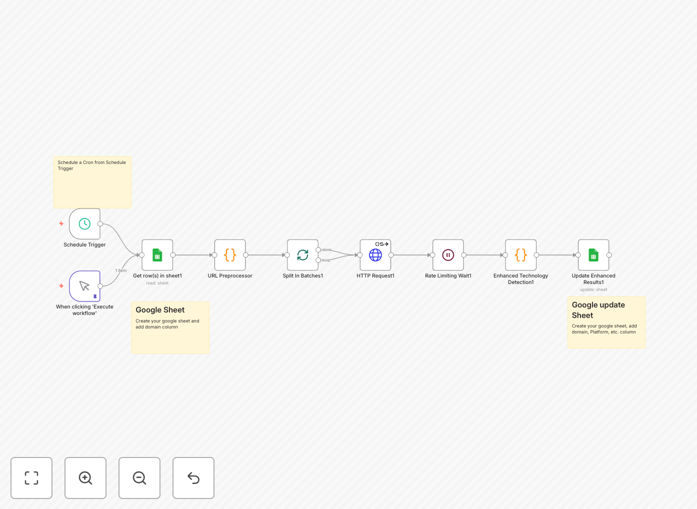
Screenshot of e-commerce technology detection workflow in n8n

What This Workflow Does

This automation solves the time-consuming challenge of manually researching competitors' e-commerce technology stacks. The workflow automatically analyzes websites to detect their underlying platforms (Shopify, BigCommerce, etc.), payment processors (Stripe, PayPal), marketing tools, and technical frameworks.

By connecting website analysis with Google Sheets, you create a living database of competitor technology intelligence that updates automatically. This eliminates the need for manual detective work while providing more accurate and comprehensive data than human researchers can typically gather.

How It Works

Step 1: Input website URLs

The workflow accepts a list of website URLs from your Google Sheet or other data source. These can be competitors, potential partners, or market research targets.

Step 2: Analyze website technology

Using advanced detection methods, the workflow scans each website's code, APIs, and DNS records to identify telltale signs of specific e-commerce platforms and technologies.

Step 3: Classify findings

Detected technologies are categorized into logical groups: e-commerce platforms, payment processors, analytics tools, marketing systems, and technical frameworks.

Step 4: Update Google Sheets

The workflow writes all findings back to your Google Sheet with clear labels and categorization, creating an automatically updating competitive intelligence database.

Who This Is For

This workflow is ideal for e-commerce managers, digital marketers, business analysts, and technology consultants who need to:

  • Conduct competitive market research
  • Identify integration partnership opportunities
  • Benchmark technology adoption trends
  • Inform platform migration decisions
  • Support sales and business development efforts

What You'll Need

  1. An n8n instance (cloud or self-hosted)
  2. A Google Sheets account
  3. A list of target website URLs
  4. Basic familiarity with n8n workflows

Quick Setup Guide

  1. Download the template file
  2. Import into your n8n instance
  3. Connect your Google Sheets account
  4. Configure your target URL source
  5. Run the workflow manually or schedule automatic updates

Key Benefits

Save 20+ hours per month by automating what would otherwise require manual website inspection and research.

Discover hidden opportunities by identifying compatible technologies among partners and competitors.

Make data-driven decisions with accurate, up-to-date information about market technology adoption.

Scale your research to analyze hundreds of websites with the same effort as analyzing one.

Frequently Asked Questions

Common questions about e-commerce technology detection and automation

Identifying e-commerce tech stacks helps businesses analyze competitors, identify integration opportunities, and benchmark performance. This automation saves hours of manual research by automatically detecting platforms like Shopify, WooCommerce, or Magento along with their supporting technologies.

For example, a marketing agency can use this data to recommend platform-specific optimizations to clients, while SaaS companies can identify potential integration partners based on the technologies their prospects already use.

  • Reveals competitor strengths and weaknesses
  • Identifies compatible integration partners
  • Provides market adoption benchmarks

This workflow can identify CMS platforms, payment processors, analytics tools, marketing automation systems, and frontend frameworks. It detects technologies like Stripe, PayPal, Google Analytics, HubSpot, React, and Vue.js by analyzing website code and API signatures.

The detection covers the full technology stack from infrastructure (hosting providers) to frontend libraries. For example, it can identify if a site uses Cloudflare CDN, Shopify's Liquid templating, and Klaviyo for email marketing.

  • E-commerce platforms (Shopify, Magento, etc.)
  • Payment processors and gateways
  • Marketing and analytics tools

Modern detection methods achieve 85-95% accuracy by analyzing multiple signals including JavaScript libraries, HTML patterns, API calls, and DNS records. The workflow cross-references multiple data points to minimize false positives.

For common platforms like Shopify or WooCommerce, accuracy approaches 98% because they leave distinctive technical fingerprints. Custom-built solutions are harder to identify but still reveal telltale signs through their payment processors and analytics integrations.

  • Higher accuracy for popular platforms
  • Multiple verification methods reduce errors
  • Continually updated detection patterns

Absolutely. Automated tech stack analysis provides actionable competitive intelligence by revealing what technologies competitors use for payments, hosting, marketing, and analytics. This helps businesses identify market trends and potential advantages.

For instance, discovering that most competitors use Shopify with specific apps can inform your own platform strategy. Or finding that none use a particular payment processor might reveal an untapped opportunity.

  • Benchmark against industry standards
  • Identify technology gaps in the market
  • Spot emerging trends before competitors

Automating tech stack detection saves hundreds of research hours annually while providing more comprehensive data than manual methods. Businesses gain real-time insights for partnerships, hiring decisions, and technology investments.

A digital agency might use this to quickly assess a prospect's tech stack before a sales call, while an e-commerce brand could monitor competitors' technology shifts that might indicate new strategies.

  • Eliminates tedious manual research
  • Provides consistent, structured data
  • Enables proactive strategy adjustments

Monthly analysis provides optimal insights into technology adoption trends. The workflow can be scheduled to run automatically, ensuring your competitive intelligence stays current without manual effort.

E-commerce platforms and tools change frequently, so regular analysis catches migrations (like a competitor moving from Magento to Shopify) or new technology adoptions (adding Afterpay payments or TikTok Pixel).

  • Monthly updates catch meaningful changes
  • Automated scheduling requires no effort
  • Historical data reveals trends over time

Yes! GrowwStacks specializes in building custom automation solutions for e-commerce businesses. Our team can create tailored workflows that integrate with your existing systems and provide the specific competitive intelligence you need.

We'll work with you to understand your unique requirements, whether you need deeper technology analysis, integration with your CRM, or specialized reporting. Our solutions save you time while delivering actionable business insights.

  • Fully customized to your needs
  • Seamless integration with your tools
  • Ongoing support and optimization

Need a Custom E-commerce Technology Detection Solution?

This free template is a starting point. Our team builds fully tailored automation systems for your specific needs.