What This Workflow Does
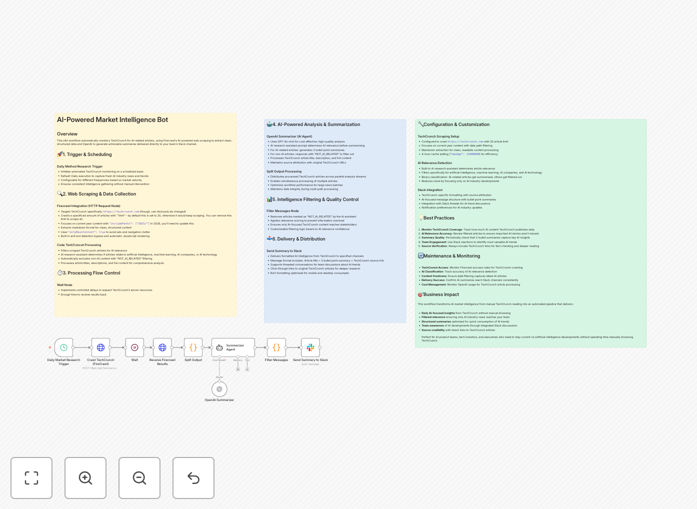
This automation solves the challenge of staying updated on AI developments without spending hours manually scanning news sites. TechCrunch publishes dozens of articles daily, but only a fraction relate specifically to artificial intelligence. The workflow automatically identifies relevant content, extracts key insights, and delivers concise summaries directly to your team's Slack channel.
By combining web scraping with OpenAI's natural language processing, the system filters out irrelevant articles while preserving important AI-related news. Each summary includes the article's core points, saving your team from reading full pieces that may not be pertinent. The result is a streamlined information pipeline that keeps everyone informed without information overload.
How It Works
1. Fetching TechCrunch articles
The workflow begins by scraping TechCrunch's RSS feed or website to collect recent articles. It extracts key metadata including titles, URLs, publication dates, and full text content. This creates a pool of potential articles for AI analysis.
2. AI content filtering
Each article gets processed through OpenAI's API to determine its relevance to artificial intelligence. The system analyzes text patterns, keywords, and contextual clues to score each piece's AI focus. Only articles passing a customizable threshold proceed to summarization.
3. Generating summaries
For qualifying articles, OpenAI generates concise summaries highlighting key points while preserving accuracy. The AI extracts core concepts, technical developments, and business implications in 3-5 bullet points or a short paragraph format.
4. Delivering to Slack
Final summaries get formatted with source links and published to your designated Slack channel. The workflow includes error handling to manage API limits, connectivity issues, and content formatting requirements.
Pro tip: Adjust the AI sensitivity threshold based on how narrowly you want to define "AI-related" content. Higher values catch only pure AI topics while lower values include adjacent tech areas.
Who This Is For
This workflow benefits any team needing to track AI developments without manual effort. Ideal users include:
- AI product managers monitoring competitive developments
- Research teams staying current on technical breakthroughs
- VC firms tracking startup activity in artificial intelligence
- Corporate innovation teams identifying emerging AI applications
- Marketing teams watching AI industry trends
What You'll Need
- An n8n instance (cloud or self-hosted)
- OpenAI API access with available credits
- A Slack workspace with webhook permissions
- Basic familiarity with n8n workflows
Quick Setup Guide
- Download the JSON template file
- Import into your n8n instance
- Configure your OpenAI API credentials
- Set up your Slack incoming webhook
- Adjust filtering thresholds as needed
- Test with sample articles
- Schedule regular execution (daily recommended)
Key Benefits
Saves 5+ hours weekly by automating what would otherwise require manual article scanning and reading. The AI handles the tedious filtering work so your team can focus on insights.
Improves information quality with consistent, unbiased article selection based on content rather than headlines or popularity. The system won't miss important niche developments.
Customizable precision lets you control how narrowly the system defines AI relevance. Adjust over time as your interests evolve without rebuilding the workflow.
Scalable monitoring that can expand to additional news sources with minimal configuration changes. The core filtering logic works across publications.