n8n Security AI Automation Bug Bounty

Monitor new CVEs for bug bounty hunting with Gemini AI and Slack alerts

Automatically scans NIST's CVE database hourly, uses Gemini AI to assess exploit potential, and delivers prioritized Slack alerts for high-value vulnerabilities. Save hours of manual research and get first-mover advantage in bug bounty programs.

Download Template JSON · n8n compatible · Free
CVE monitoring workflow dashboard showing AI analysis results

What This Workflow Does

Bug bounty hunters face an overwhelming stream of new vulnerabilities published daily in the NIST National Vulnerability Database. Manually sifting through hundreds of CVEs to find exploitable targets wastes precious time and risks missing high-value opportunities.

This automated workflow solves this problem by continuously monitoring new CVEs, analyzing them with Gemini AI for bug bounty potential, and delivering prioritized Slack alerts. It acts as your 24/7 research assistant, ensuring you never miss a critical vulnerability matching your hunting criteria.

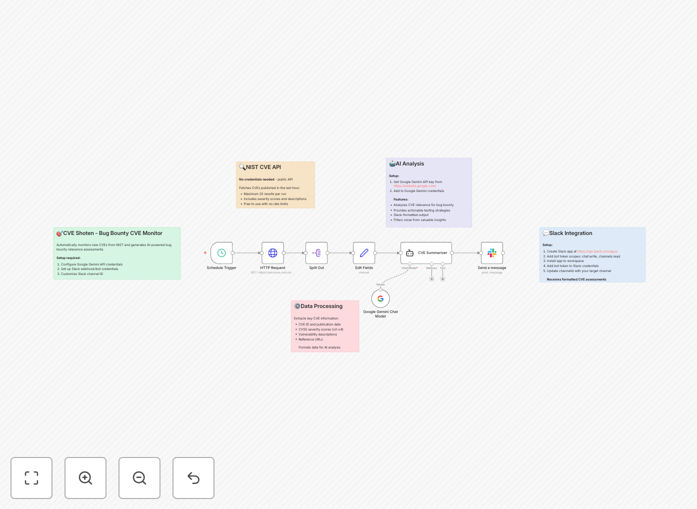
Workflow diagram showing CVE monitoring process
Automated pipeline from CVE detection to AI analysis and Slack notification

How It Works

1. Continuous CVE Monitoring

The workflow queries NIST's CVE database every hour using their API, checking for newly published vulnerabilities. It filters out low-severity CVEs (below 6.0 CVSS score) to focus on potentially exploitable targets.

2. AI-Powered Analysis

Each qualifying CVE gets processed by Gemini AI, which evaluates factors like attack complexity, potential impact, affected software popularity, and existing exploit availability. The AI assigns a "bounty potential" score from 1-10.

Pro tip: Customize the AI prompt to prioritize vulnerabilities in technologies you specialize in (e.g., WordPress plugins, cloud services).

3. Smart Alert Prioritization

The system compares each CVE's AI score against your configured threshold. Only high-potential vulnerabilities trigger Slack alerts, with clear severity indicators and quick assessment summaries.

Who This Is For

This workflow delivers maximum value for:

  • Professional bug bounty hunters wanting to scale their research
  • Security teams monitoring for emerging threats
  • Penetration testers staying current on new vulnerabilities
  • CTF players looking for fresh exploit opportunities

What You'll Need

  1. An n8n instance (cloud or self-hosted)
  2. Google Cloud API key for Gemini AI access
  3. Slack workspace with incoming webhook permissions
  4. Basic understanding of CVSS scoring

Quick Setup Guide

  1. Download and import the JSON template into your n8n instance
  2. Configure your Google Cloud API credentials
  3. Set up Slack incoming webhook integration
  4. Adjust severity thresholds and target technologies
  5. Activate the workflow and test with sample CVEs

Key Benefits

Save 10+ hours weekly by automating vulnerability research instead of manual CVE monitoring.

Increase bounty earnings by being first to discover and report high-value vulnerabilities.

Reduce alert fatigue with AI-filtered notifications showing only relevant CVEs.

Stay ahead of competitors with real-time alerts the moment new vulnerabilities publish.

Frequently Asked Questions

Common questions about CVE monitoring and bug bounty automation

AI transforms bug bounty hunting by automatically analyzing new vulnerabilities for exploit potential. Gemini AI evaluates CVEs based on factors like attack complexity, impact severity, and public exploit availability. This prioritizes high-value targets while filtering out low-relevance vulnerabilities, saving researchers hours of manual analysis each day.

The workflow combines AI's pattern recognition with human expertise. While researchers still need to verify findings, AI handles the initial triage at scale. This balanced approach maximizes productivity without compromising accuracy in vulnerability assessment.

  • Identifies patterns across related vulnerabilities
  • Learns your target technology preferences
  • Adapts to new exploit techniques over time

Automated CVE monitoring provides first-mover advantage in bug bounty programs. The workflow checks NIST's database hourly, ensuring you're alerted to new vulnerabilities before most competitors. Real-time Slack notifications with AI-assessed severity scores let you quickly evaluate whether to pursue each vulnerability.

Beyond speed, automation ensures comprehensive coverage. Manual monitoring often misses vulnerabilities published during off-hours or in less visible feeds. The system works 24/7, applying consistent evaluation criteria across all CVEs regardless of when they're published.

Modern AI models like Gemini achieve 85-90% accuracy in preliminary vulnerability assessments when properly configured. The workflow combines AI analysis with traditional CVSS scoring for balanced evaluation. Researchers should still verify critical findings, but AI dramatically reduces the noise in vulnerability monitoring.

Accuracy improves when the AI specializes in specific technology stacks. The workflow allows training the model on your preferred targets, reducing false positives for irrelevant systems. Over time, the system learns your verification patterns to refine its scoring.

High-value vulnerabilities typically include remote code execution, privilege escalation, and authentication bypass flaws in widely-used software. The AI prioritizes CVEs affecting popular frameworks, content management systems, and enterprise software where bug bounty programs are most active.

The workflow focuses on vulnerabilities with clear paths to exploitation. While theoretical risks matter for patching, bug hunters need practical exploit potential. The AI scores vulnerabilities higher when they affect internet-facing components with available proof-of-concept code.

Serious bug bounty hunters should monitor CVEs at least hourly during business hours. This workflow automates continuous monitoring without manual effort. The AI filters ensure you only get notified about relevant vulnerabilities matching your target technologies and exploit criteria.

Frequency matters because early reporters earn higher bounties. Programs often reduce payouts as more researchers submit the same vulnerability. Automated monitoring lets you respond within minutes rather than waiting for daily digest emails.

Yes, the workflow allows configuring specific parameters for AI evaluation. You can prioritize vulnerabilities affecting certain technologies, set minimum severity thresholds, or focus on particular attack vectors. Advanced users can modify the Gemini prompts to emphasize factors most relevant to their hunting strategy.

Customization helps specialists focus on their niche. WordPress plugin researchers might weight authentication flaws higher, while API security experts could prioritize input validation issues. The workflow supports these specializations through adjustable scoring parameters.

Absolutely. GrowwStacks specializes in tailored security automation solutions. We can build custom workflows integrating your preferred tools, target technologies, and notification preferences. Our team will configure AI models to match your specific bug hunting methodology and integrate with your existing security stack.

Custom solutions work best for teams with specialized needs. We'll analyze your current research process, identify automation opportunities, and design workflows that complement your expertise. The result is a system that amplifies your strengths rather than replacing your judgment.

Need a Custom Bug Bounty Automation?

This free template is a starting point. Our team builds fully tailored automation systems for your specific needs.