Zapier Hiring AI Automation

Screen and score resumes from Gmail with PDF parsing, HubSpot, Slack and PostgreSQL

Automate resume screening with AI-powered PDF parsing, scoring, and distribution to HubSpot, Slack and PostgreSQL

Download Template JSON · Zapier compatible · Free
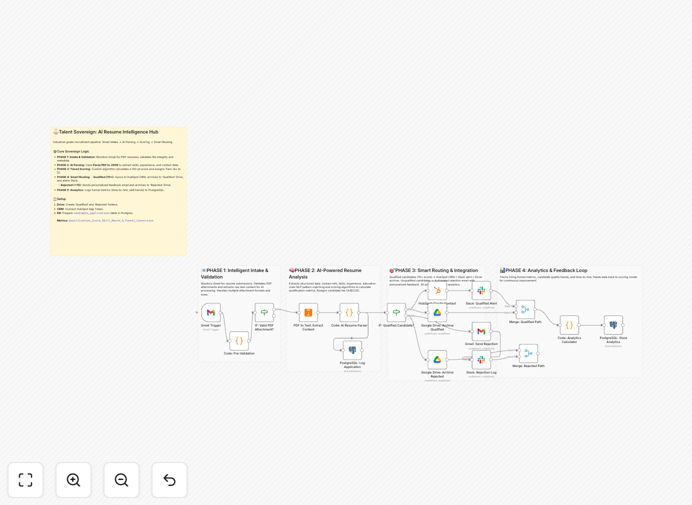
Resume screening automation workflow diagram

What This Workflow Does

This automation transforms your recruitment process by automatically screening and scoring resumes received via email. It eliminates manual resume sorting by extracting candidate information from PDF attachments, analyzing content against your criteria, and distributing qualified candidates to your HR systems.

The workflow integrates Gmail with AI-powered PDF parsing to extract candidate details, scores resumes based on your predefined criteria, logs candidates in HubSpot CRM, notifies your team in Slack, and stores all data in PostgreSQL for reporting. This creates a complete talent acquisition pipeline without manual data entry.

How It Works

1. Email Trigger

The workflow monitors your Gmail inbox for new messages containing resume attachments. When a candidate submits their resume via email, the automation begins processing immediately.

2. PDF Parsing & Data Extraction

AI-powered PDF parsing extracts candidate information including name, contact details, skills, education, and work experience. The system converts unstructured resume data into structured fields for analysis.

3. Automated Scoring

Each resume is scored against your predefined criteria (keywords, skills, experience levels). The system calculates a suitability score and flags top candidates based on your thresholds.

4. System Integration

Qualified candidates are automatically added to HubSpot as contacts with their resume details. Your recruitment team receives Slack notifications with candidate summaries. All data is logged in PostgreSQL for analytics.

Who This Is For

This workflow is ideal for HR teams, recruitment agencies, and hiring managers who receive high volumes of resumes via email. Companies with structured hiring processes will benefit most from the automated scoring and distribution.

Tech startups, scaling businesses, and enterprises can all leverage this solution to reduce time-to-hire and improve candidate quality. It's particularly valuable for roles with specific skill requirements that can be quantified in scoring criteria.

What You'll Need

  1. A dedicated Gmail account for resume submissions
  2. HubSpot CRM account (free or paid)
  3. Slack workspace for notifications
  4. PostgreSQL database (or compatible alternative)
  5. Zapier account with premium plan for PDF parsing

Quick Setup Guide

  1. Download and import the JSON template into your Zapier account
  2. Connect your Gmail, HubSpot, Slack and PostgreSQL accounts
  3. Configure your scoring criteria (keywords, skills, experience levels)
  4. Set up notification channels in Slack
  5. Test with sample resumes to validate parsing and scoring

Key Benefits

Reduce screening time by 80%: Automatically process hundreds of resumes without manual review, focusing only on pre-qualified candidates.

Improve hiring quality: Consistent scoring eliminates human bias and ensures all candidates are evaluated against the same criteria.

Centralize candidate data: All applicant information flows automatically into your CRM and database, creating a single source of truth.

Accelerate response times: Immediate processing means you can engage top candidates faster than competitors.

Gain hiring insights: PostgreSQL storage enables analysis of applicant trends, source quality, and hiring funnel metrics.

Frequently Asked Questions

Common questions about resume screening automation

Automated screening applies consistent evaluation criteria to every applicant, eliminating human bias in initial reviews. The system scores candidates objectively based on your predefined requirements for skills, experience, and qualifications.

For example, a tech company can configure the system to prioritize candidates with specific programming languages or certifications. This ensures all applicants are measured against the same standards, surfacing the most qualified candidates regardless of resume formatting or presentation style.

  • Reduces unconscious bias in early screening
  • Ensures consistent evaluation standards
  • Surfaces candidates with hard-to-find skills

Modern PDF parsing can accurately extract candidate names, contact information, education history, work experience, skills, certifications, and sometimes even project details. The technology understands resume structures and contextual relationships between sections.

Advanced systems can identify skill proficiency levels based on context (e.g., "5 years of Python" vs "familiar with Python"). Some can even extract soft skills and achievements when properly formatted in the resume. The extracted data becomes searchable fields in your database.

  • Converts unstructured resumes into structured data
  • Identifies both hard and soft skills
  • Captures years of experience for each skill

Effective scoring starts with identifying must-have qualifications and nice-to-have attributes for the role. Assign higher weights to critical skills and experience levels. Include negative scoring for disqualifiers like employment gaps or job hopping.

A software engineering role might score heavily for specific programming languages, while a sales position might prioritize industry experience. The best systems allow different scoring profiles for different job types and can learn from your hiring decisions over time.

  • Weight must-have qualifications higher
  • Include negative scoring for red flags
  • Create different profiles for different roles

Automation typically reduces screening time by 75-90%, allowing recruiters to focus on engaging top candidates rather than administrative review. For a role receiving 200 applications, this can save 25+ hours per hiring cycle in manual screening alone.

The bigger value comes from improved quality of hire and reduced time-to-fill. Companies report 30-50% improvements in candidate quality scores and 20-40% reductions in time-to-hire metrics after implementing automated screening. These translate directly to bottom-line impact through faster productivity and lower turnover.

  • Saves 25+ hours per 200 applications
  • Reduces time-to-hire by 20-40%
  • Improves quality of hire metrics

This workflow complements rather than replaces your ATS. It handles the initial screening and data extraction that often happens before candidates enter the formal ATS pipeline. The automation works with email submissions that might otherwise require manual data entry.

Unlike many ATS systems, this solution provides customizable scoring and direct integration with team collaboration tools like Slack. It's particularly valuable for high-volume roles or when sourcing candidates through non-traditional channels that don't go through your career portal.

  • Works with email-sourced candidates
  • Provides more flexible scoring than most ATS
  • Integrates directly with team chat tools

While candidates can optimize resumes with keywords, sophisticated systems evaluate context and experience levels rather than just keyword presence. Scoring algorithms can detect keyword stuffing and evaluate how skills are demonstrated through work history.

The best defense is a multi-dimensional scoring approach that considers skill proficiency, years of experience, career progression, and achievement metrics. Regular calibration of scoring criteria based on actual hire performance also improves system accuracy over time.

  • Contextual analysis prevents simple keyword gaming
  • Multi-dimensional scoring evaluates real proficiency
  • System learns from your successful hires

Absolutely. GrowwStacks specializes in building tailored recruitment automation solutions that match your specific hiring workflows and tech stack. We can create custom scoring models, integrate with your existing HR systems, and design workflows that reflect your unique candidate evaluation process.

Our team will analyze your current hiring bottlenecks, identify optimization opportunities, and implement a solution that saves time while improving candidate quality. We support all major HR platforms and can build bridges between systems that don't normally communicate.

  • Custom scoring for your specific roles
  • Integration with your existing HR tech
  • Ongoing optimization based on results

Need a Custom Resume Screening Automation?

This free template is a starting point. Our team builds fully tailored automation systems for your specific needs.